NEW YORK — Apple’s blowout quarterly gross margin of 49.3% handed traders exactly the kind of earnings anchor they needed heading into a long weekend, lifting the Nasdaq Composite above 25,183 and pulling the S&P 500 through 7,252 at midday on the final session of what has already been the market’s best month in five years.
Two Catalysts, One Rally — What Is Actually Driving the Tape
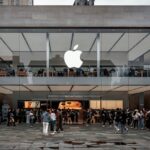
The session opened with hesitation. Early futures softened on residual April inflation anxiety, and the market entered May knowing it had already banked a 10% April gain that left little room for disappointment. Then Apple printed. Fiscal second-quarter results showed gross margin at 49.3%, a clean beat versus the 48.4% consensus, and the revenue outlook for the current quarter came in above Street expectations. The stock cleared 4% before 10 AM and hasn’t looked back.
Simultaneously, news broke that Pakistani mediators had facilitated a new Iranian proposal in the ongoing U.S.-Iran conflict. Crude oil futures dropped sharply toward $101.63, shedding more than 3% on the session. That move matters beyond energy stocks — oil above $106 had been the single biggest structural threat to the Federal Reserve’s rate-cut window, a concern this desk flagged explicitly last week. A sustained pullback in crude reframes the macro backdrop for rate-sensitive sectors, even if the ceasefire remains unconfirmed.
The Dow Jones Industrial Average sits nearly flat at 49,641.99 (-0.02%), a tell that the afternoon has not been a broad-based institutional rotation so much as a concentrated bet on tech and large-cap growth. The Russell 2000’s 0.34% gain adds some texture — small caps are participating, but they are not leading.
Apple Lifts Tech — But the Rest of the Story Is Messier
Technology leads all eleven S&P 500 sectors at +1.57% midday, with Consumer Cyclical second at +1.18% and Financials adding a modest +0.51%. Those three sectors tell a coherent story: earnings confidence is driving capital toward growth and risk. The other eight sectors are essentially flat or negative, with Energy the clear laggard at -1.18% as crude’s selloff hammers the refiners and producers that had been this year’s unexpected beneficiaries of war-premium crude.
Apple’s 4.64% gain leads the Dow, followed by Merck at +4.10% — a pairing that reflects how differently today’s session is treating companies that beat versus those that missed or warned. Amgen’s -4.47% decline is the Dow’s biggest drag, underscoring that healthcare isn’t offering refuge today. Salesforce at +2.33% adds to the enterprise software bid.
The AI capital expenditure narrative continues to bifurcate the tech tape in ways that matter for positioning. Analysts tracking hyperscaler spending note that AI capex could approach $700 billion in 2026, a figure that sounds uniformly bullish until you separate the winners from the casualties. Markets are rewarding AI spending that demonstrates near-term monetization — Alphabet drew applause — and punishing spending that looks like a faith-based wager. That distinction is now the most important analytical framework for navigating the AI trade, not the raw capex number itself.
Roblox delivered the session’s most punishing data point. The company slashed its full-year 2026 bookings guidance to a range of $5.87 billion to $6.14 billion, down from a prior outlook of $6.02 billion to $6.29 billion. The stock fell 24% in premarket. For a platform business with a young demographic and discretionary spending exposure, that guidance cut lands hard in a consumer environment where households are still absorbing elevated gasoline prices. Apple’s beat may dominate the earnings headlines today, but Roblox is a useful reminder that not every tech name is benefiting from the same tailwinds.
Energy’s Complicated Session — Beats That Hide Deeper Pain
Exxon Mobil and Chevron both beat first-quarter Wall Street expectations. Exxon earned $1.16 per share on revenue of $85.14 billion, while Chevron delivered $1.41 per share on an adjusted basis, well above LSEG’s 95-cent estimate. The headline beats look clean. The underlying results are not.
Strip out financial hedges and accounting items, and Exxon’s net income declined 45%. Chevron’s tumbled 36%. The U.S.-Iran conflict delayed shipments and generated charges that the adjusted numbers smooth over but do not erase. Both stocks are sliding — Chevron -0.81% — even as the broader market rallies, a signal that institutional holders are reading through the beats to the structural damage underneath. Energy sits at -1.18% for the session, the worst-performing sector by a wide margin, and crude’s drop toward $101 may alleviate geopolitical risk but simultaneously compresses the revenue line for every barrel these companies produce going forward.
Spirit Airlines’ collapse closes a chapter that was arguably inevitable. Spirit Aviation Holdings fell 62% to 52 cents as the carrier advanced liquidation plans after failing to secure enough bondholder support for a $500 million government rescue package. The airline had been a cautionary tale about leveraged balance sheets in a high-fuel-cost environment for the better part of two years. Today’s move is the market formally closing the book.
What the Afternoon Needs to Prove
Three things define the afternoon setup. First, the S&P 500’s hold above 7,200. That level broke as a ceiling this week — the index sealed its best April in six years before testing the figure — and its first real test as support will tell traders whether the breakout was conviction-driven or liquidity-thin. A close above 7,250 would be technically constructive. A fade below 7,200 into the final hour would invite Friday afternoon profit-taking from traders unwilling to carry geopolitical risk over a weekend with an unconfirmed ceasefire.
Second, oil. Crude at $101.63 is not yet low enough to declare the inflationary energy impulse dead. It would need to sustain a move below $100 — the psychological handle that the Fed’s internal models treat as the threshold for meaningful consumer price relief on fuel. The ceasefire proposal is a catalyst, not a resolution. If weekend diplomacy stalls, oil could gap back above $105 by Monday’s open.
Third, the VIX. At 16.71 it sits at a nearly two-week low, implying that options markets have pulled back sharply from the fear premium of the prior fortnight. The rally’s staying power depends on whether that complacency is earned or premature. A VIX that stays below 17 into the close would confirm that institutional hedgers are comfortable with the weekend setup. One that climbs back toward 18 or 19 before 4 PM would suggest the opposite — that the afternoon rally is being sold into by the same desks that bid the morning.
| Level / Event | Value | Signal |
|---|---|---|
| S&P 500 key support | 7,200 | First real test as floor; close below signals failed breakout and weekend risk-off |
| VIX inflection level | 17.00 – 18.00 | Move back above 18 before close indicates hedgers selling into rally; stay below 17 confirms risk-on close |
| Crude oil psychological floor | $100.00 | Sustained break below $100 opens door for Fed rate-cut repricing; failure to hold raises weekend gap-up risk if ceasefire stalls |
| Apple (AAPL) intraday hold | +4% gain | If AAPL fades below +2% into the close, Tech sector leadership loses its anchor and Nasdaq consolidation becomes likely |
| Iran ceasefire confirmation | Unconfirmed | Official confirmation before close would accelerate energy selloff and extend risk-on; weekend silence re-introduces geopolitical premium Monday morning |
The afternoon setup is tactically constructive but not clean. Apple’s margin story gives the Nasdaq a genuine fundamental reason to hold its gains. The Iran headline gives traders a geopolitical excuse to reduce defensive hedges. Neither story is resolved by 4 PM. Sellers who locked in April’s 10% gain have every rational reason to reduce exposure into a weekend with an unconfirmed ceasefire and crude still above $100. The AI spending differentiation that emerged this earnings season suggests the next leg of the tech trade will require more than capex ambition — it will require proof that the dollars are converting to revenue. Apple, for one quarter at least, made that case. The rest of the sector is still building it.
This article is published by PreMarket Daily for informational purposes only. Nothing here constitutes financial advice, investment recommendations, or an offer to buy or sell any securities. Always consult a qualified financial professional before making investment decisions.