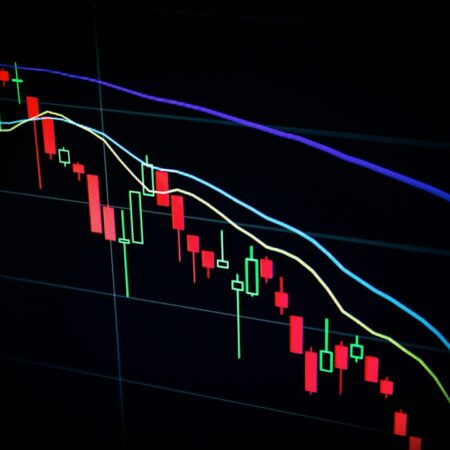
NEW YORK — The S&P 500 enters Monday morning with no major economic data on the calendar and every serious trader’s attention already trained on Friday — when the April employment report lands with consensus expecting just 49,000 new jobs, the softest payroll reading in more than two years.
A Week That Hasn’t Started Yet
Monday’s session is, bluntly, a waiting room. The Federal Reserve’s policy-sensitive data calendar doesn’t fire until Friday with April Nonfarm Payrolls, followed by April CPI on May 12 and PPI on May 13. That sequencing means the next ten trading days will almost certainly do more to reprice risk than the next ten hours. The last significant macro input was Q1 GDP at 2.0% annualized — a number that confirmed deceleration without triggering panic.
That 2.0% print matters more than most commentary gave it credit for. Growth at that pace is not a recession. But it is a level at which corporate earnings guidance becomes fragile, consumer spending assumptions get stress-tested, and the Fed finds itself with less room to declare victory on either front of its dual mandate. The softness is real. The question is whether it deepens.
What the Payroll Consensus Is Actually Saying
A consensus estimate of 49,000 jobs for April is not a forecast — it is a warning. For context, the U.S. economy averaged roughly 190,000 monthly payroll additions through 2025. A print near 49,000 would mark the weakest month since the post-pandemic normalization period and would almost certainly push the unemployment rate toward 4.3%, the consensus call, from its most recent reading. The Bureau of Labor Statistics releases the data Friday at 8:30 AM ET.
Here is what makes this week’s setup unusual: the soft consensus is itself a market-moving variable. When the Street is braced for a weak number, a miss becomes psychologically amplified. A beat — say, 90,000 or above — would scramble rate-cut positioning that has quietly been building since the Q1 GDP release. Traders who are long duration into Friday are taking a two-sided risk that the price action hasn’t fully acknowledged.
The Growth Deceleration in Context
The 2.0% Q1 GDP number sits inside a clear downward trend. Growth ran at 3.1% in Q2 2025, slipped to 2.8% in Q3, eased further to 2.4% in Q4, and has now printed at 2.0% to open 2026. That is four consecutive quarters of deceleration — not a crash, but a steady bleed that accumulates. Wall Street Journal coverage of the GDP release noted that the composition of growth shifted in Q1, with consumer spending contributing less and inventory builds doing more of the arithmetic work — a mix that tends not to sustain.
For equity markets, the distinction between “slow growth” and “no growth” is enormous. Slow growth at 2.0% still allows for earnings expansion if margins hold. Below 1.5% — and especially if the jobs market cracks alongside it — the earnings story changes. The S&P 500’s current valuation embeds a soft-landing scenario. That scenario still has a defensible probability. But it is narrowing.
As we tracked last week, April’s 10% rally has inflation risk embedded in its foundation — and a labor market that starts deteriorating faster than expected would test whether that rally was earned or borrowed.
What the Fed Hears When It Reads These Numbers
The Federal Reserve’s next scheduled decision falls in mid-June. Between now and then, policymakers will have seen April payrolls, April CPI, April PPI, and April retail sales. That is a complete picture of where the economy stood at the start of Q2 — and if each of those prints undershoots, the pressure to cut rates in June becomes substantial.
Fed funds futures currently imply a roughly 30-35% probability of a June cut, a figure that would reprice sharply higher if Friday’s payroll number comes in near or below consensus. A June cut is not the base case. But it is no longer the fringe scenario it was three months ago.
The more nuanced Fed debate is not about June — it’s about the sequencing of the second half. If the Fed cuts in July and September, that’s a very different equity and credit environment than one where cuts start in September and end there. Traders focused purely on whether June happens are missing the larger positioning question.
For further context on how big-technology earnings have been interacting with this macro backdrop, see our earlier analysis: Can Big Tech Earnings Justify a Market at Record Highs?
The Levels That Will Define This Session
With no 8:30 AM catalyst today, the open is effectively a function of overnight positioning and whatever momentum carries over from last week’s close. The practical question is where the S&P 500 finds support if sentiment drifts lower ahead of Friday, and where resistance sits if dip-buyers emerge early.
The 10-year Treasury yield is the single most important number on any trader’s screen this week. It is simultaneously a gauge of growth expectations, inflation expectations, and Fed policy probability — and it will move before equities do when Friday’s print crosses the tape. Follow the 10-year live on MarketWatch.
Also worth watching: the S&P 500’s 7,200 level, which has emerged as the technical line in the sand for the current rally’s credibility.
| Level / Event | Value | Signal |
|---|---|---|
| April NFP Consensus | 49,000 | A miss below 30K reprices June cut odds sharply higher; a beat above 90K unwinds rate-cut positioning |
| Unemployment Consensus | 4.3% | 4.4% or above triggers recession-narrative headlines; 4.2% or below is a relief valve for equity bulls |
| 10-Year Treasury Yield | ~4.30% | Break below 4.20% post-jobs = rate-cut trade live; hold above 4.40% = Fed patience trade intact |
| S&P 500 Key Support | 7,200 | Holding this level through Friday keeps the April rally thesis intact; losing it opens a test of 7,050 |
| April CPI Release | May 12 | The second-order risk this week — hot inflation alongside weak jobs would put the Fed in an impossible position |
What Monday Actually Tells You
There is a version of this week where Monday’s quiet is deceptive. Institutional desks don’t sit on their hands in low-volume sessions — they reposition. The drift in futures this morning is as much about where large players want to be when Friday hits as it is about any organic view on the economy. That means today’s price action carries a signal, even if it looks like noise.
Watch breadth at the open. A market that can’t hold gains even without a negative catalyst — on a Monday, before a major data week — is telling you something about how much conviction the current level commands. Conversely, if buyers step in at the first dip and hold it, that’s positioning for a soft jobs number being the trade they want to be in.
The S&P 500 has built a strong foundation over recent weeks, but as our earlier analysis explored, the best April in six years may carry structural vulnerabilities that a softening labor market could expose.
The honest assessment heading into this week: the data is weak enough to justify caution but not weak enough — yet — to justify panic. Q1 GDP at 2.0% is a slowdown, not a collapse. A 49,000 payroll print, if confirmed, is a deterioration that the Fed will monitor, not an emergency it will respond to immediately. The equity market’s reaction to Friday’s number will tell traders more about positioning and sentiment than it will about the actual state of the economy. Watch the bond market first. The stock market will follow.
This article is published by PreMarket Daily for informational purposes only. Nothing here constitutes financial advice, investment recommendations, or an offer to buy or sell any securities. Always consult a qualified financial professional before making investment decisions.

Other Articles