

NEW YORK — Kevin Warsh walked into his first Federal Reserve press conference as Chairman on Wednesday and, within the span of one hour, erased months of market complacency about the rate path — sending the S&P 500 down 1.21% to 7,420.10 in the final hour of trading.
The Session That Rewrote the Rate Script
For most of Wednesday’s session, markets were orderly. The S&P 500 opened at 7,524.50 and traded as high as 7,532.17 in morning trade, with the Dow holding near flat and small-caps actually flashing green — the Russell 2000 reached an intraday high of +1.24% before the afternoon turned ugly. The Nasdaq-100 even managed to close in the black, up 0.42% to 30,093.33, buoyed by a semiconductor bid that saw Micron Technology, Lam Research, and Marvell each gain at least 3% in early trade.
Then Warsh spoke. The FOMC held the benchmark federal funds rate at 3.5%–3.75%, as expected. What was not fully expected was the combination of three simultaneous signals: the removal of easing bias language from the policy statement, Warsh’s refusal to submit his own rate forecast to the dot plot, and — most consequentially — the dot plot itself showing several officials now anticipate a rate increase before year-end. The median 2026 year-end rate estimate jumped to 3.8% from 3.4% in March, implying at least one hike is being seriously contemplated inside the building.
Jefferies Chief Market Strategist David Zervos captured the reaction succinctly, and he had been warning about exactly this dynamic. As we explored ahead of today’s decision, the question was never purely about the rate itself — it was about what kind of Fed institution Warsh intended to run. Wednesday answered that question in full.
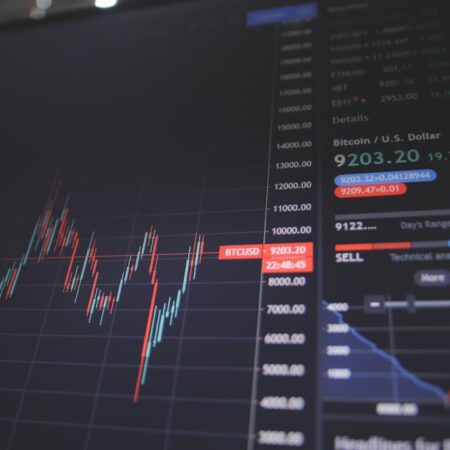
The 10-year Treasury yield climbed to 4.49%, up six basis points on the day. Gold, which had been trading as a geopolitical hedge given President Trump’s G7 comments that the US-Iran memorandum of understanding is “not final” and that he would resume military action if he dislikes the terms, reversed sharply — falling $95.10 to $4,286.30. Bitcoin dropped 2.11% to $64,324.79. When real rates rise and the Fed’s reaction function becomes opaque, liquidity-sensitive assets tend to reprice fast, and Wednesday was a clean example of that dynamic playing out in real time.
As this publication noted before Warsh took the podium, the risk was not a single hawkish statement — it was the market confronting a Fed that no longer telegraphs its moves. That uncertainty premium is now visible in the VIX, which has not closed above 18 since earlier this spring.
The Fault Lines in Today’s Tape
The sector breakdown tells a more specific story than the headline index moves suggest. Communication Services collapsed 2.91%, the worst performer of the day, dragging Meta Platforms, Alphabet, and Microsoft lower alongside it. Technology fell 2.22%. Consumer Cyclicals dropped 2.34%. These are the long-duration growth areas of the market — the sectors most sensitive to a higher discount rate and the ones that have carried the most index weight through the 2025–2026 rally.
What held up deserves equal attention. Industrials gained 1.50%. Financial Services added 1.15%. Basic Materials rose 0.75%. Utilities and Real Estate both closed green. This rotation toward rate-beneficiary sectors and cyclical value names is not new — but its acceleration on a Fed day is a signal worth tracking. If the next two sessions confirm the pattern, Wednesday may mark a more durable leadership shift than a single-day reaction.
The semiconductor complex presented its own split screen. The Invesco PHLX Semiconductor ETF traded 2.4% higher in early going, with ASML and Intel each up 4% and Micron, Lam Research, and Marvell each gaining at least 3%. That strength faded into the close as the broader selloff intensified, but the sector’s early resilience points to a specific catalyst: Deutsche Bank upgraded Micron Technology to Buy with a $1,500 price target, up from $1,000, implying 47% upside. Analyst Melissa Weathers cited strong memory pricing and intra-quarter commentary pointing to a strengthening financial outlook. That upgrade — on a day when the broader tech sector shed more than 2% — is either bold timing or a deliberate signal that the semiconductor cycle is running on its own logic, independent of rate noise.
AST SpaceMobile added 6% intraday after successfully launching three new satellites via a SpaceX Falcon 9 rocket, continuing the company’s buildout of its broadband constellation. The gain held into the close, making ASTS one of the few technology-adjacent names to finish the session meaningfully in the green. And on the augmented reality front, Wells Fargo analysts delivered a cold verdict on Snap’s new AR glasses priced at $2,195, calling the product “disappointing given the length of the development cycle” and flagging the 4-hour battery life as a core commercial liability. The firm sees no meaningful near-term financial contribution from the device.
La-Z-Boy and the Earnings Story Nobody Saw Coming
Buried beneath the macro drama was one of the cleaner earnings beats of the quarter. La-Z-Boy reported fiscal Q4 2026 adjusted EPS of $1.26 against a $0.82 consensus estimate — a 53.7% beat that sent the stock up as much as 19% on the day, touching a range of $39.45 to $41.94. Revenue of $570.34 million was essentially in line with the $569.23 million estimate, meaning the upside was entirely margin-driven. Adjusted operating margin came in at 9.9%, up 50 basis points year-over-year, while gross margin hit 43.5%.
Retail segment written sales grew 11% year-over-year and delivered sales rose 9%, suggesting the consumer furniture category — left for dead by many analysts after the post-pandemic housing slowdown — is finding a second gear. The company also announced a new $300 million share repurchase authorization and guided Q1 FY2027 revenue to $490 million–$510 million, bracketing the $495 million consensus. The one area of caution: Q1 adjusted operating margin guidance of 4.0%–5.5% is well below the Q4 pace of 9.9%, implying seasonal compression and potentially elevated input costs in the near term. Still, on a day when most of the tape bled lower, La-Z-Boy’s print was a reminder that earnings fundamentals can cut through macro noise when the beat is wide enough.
What Thursday’s Open Has to Answer
The immediate question heading into Thursday is whether the selloff was a clean repricing event or the start of a more sustained de-rating of growth multiples. The S&P 500 closed at 7,420.10, having traded as low as 7,402.61 intraday. That intraday low is the first line of technical support to watch. A breach on Thursday’s open, particularly on elevated volume, would suggest the session was not cathartic — it was an opening move.
The Nasdaq-100’s ability to close green at 30,093.33 on a day when the Nasdaq Composite fell 1.34% is an anomaly that deserves scrutiny. The divergence reflects the outsized weight of mega-cap names in the QQQ universe, but it also means those names are now carrying a concentration risk if Thursday brings follow-through selling. The 30,000 level in the Nasdaq-100 is psychologically and technically significant — a close below it would shift the tone meaningfully.
Iran headlines remain a live variable. Trump’s “not final” framing on the US-Iran MOU injected energy volatility, though WTI crude ultimately settled modestly lower at $75.58. If the geopolitical situation deteriorates further, expect oil to reassert itself as a market driver — which would complicate the Fed’s inflation calculus at exactly the wrong moment. The relationship between Iran deal progress and the Fed’s room to maneuver has been a recurring theme this month, and Wednesday did nothing to simplify it.
| Level / Event | Value | Signal |
|---|---|---|
| S&P 500 intraday low support | 7,402.61 | Break below on Thursday volume signals continued de-rating, not one-day flush |
| Nasdaq-100 psychological floor | 30,000 | Close below shifts growth narrative from resilient to vulnerable; watch opening print closely |
| 10-Year Treasury Yield | 4.49% | Move toward 4.60% triggers second wave of selling in long-duration growth names |
| VIX closing level | 18.44 | Sustained hold above 18 confirms regime-change premium is structural, not episodic |
| Fed median 2026 rate forecast | 3.8% | 40-bp upward revision from March; market must now price at least one hike as non-trivial probability |
Wednesday’s close was not a market breaking down. It was a market being told the rules of the game have changed, and reacting accordingly. Whether that repricing is finished in one session or stretches across the coming weeks will depend on two things: how the next round of economic data lands against Warsh’s newly opaque framework, and whether any Fed officials push back on the dot plot’s hawkish skew in public appearances before the next FOMC meeting. Until one of those conditions resolves, the path of least resistance is lower volatility only if the data cooperates. And in Warsh’s Fed, the data is all that speaks.
This article is published by PreMarket Daily for informational purposes only. Nothing here constitutes financial advice, investment recommendations, or an offer to buy or sell any securities. Always consult a qualified financial professional before making investment decisions.

Other Articles

Is Warsh Walking Into a Market That Has Already Decided?


No Comment! Be the first one.