| Factor | Ceasefire (Apr 7–12) | Blockade (Apr 13+) |
|---|---|---|
| Hormuz traffic | IRGC coordination required; minimal transits | IRGC + US Navy both active in lanes |
| Iranian ports | Open in principle; tankers cautious | Formally blockaded effective 10 AM ET |
| Non-Iranian Gulf ports | Open; risk-assessed by operators | Formally exempt from blockade |
| WTI crude | $94.41 (post-ceasefire crash) | $104.38 (+8.1% overnight) |
| Market reaction | S&P +2.51%, 7-session winning streak | S&P futures –0.6% (pared from –1.1%) |
| Diplomatic path | Islamabad talks scheduled | Talks collapsed; no schedule |
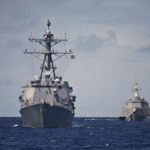
NEW YORK, April 13, 2026. The US naval blockade of Iranian port traffic that President Trump announced Sunday night and CENTCOM implements at 10 AM ET Monday is not what most traders assumed when the Truth Social post landed. Trump’s language — “BLOCKADING any and all Ships trying to enter, or leave, the Strait of Hormuz” — implied a full closure of the world’s most critical energy chokepoint. The actual CENTCOM implementation order is more precise: the blockade applies specifically to vessels entering or departing Iranian ports, not to all Strait traffic. Ships heading to UAE’s Fujairah, Qatar’s Ras Laffan, Kuwait’s Ahmadi, and Saudi offshore loading points transiting the Strait are formally exempt. That distinction shapes the oil market pricing, shipping operator decisions, and the diplomatic endgame calculus. Brent at $103 pre-market is pricing the Iranian-port-only scenario. A full Strait closure or Iranian military response to US Navy enforcement would require a substantially higher price.
Why Islamabad failed — Iran’s maximalist position unpacked
The peace talks that began Saturday in Pakistan — featuring VP Vance, Steve Witkoff, and Jared Kushner on the US side — collapsed in under 48 hours over four Iranian demands that US officials described as fundamentally incompatible with any acceptable agreement: permanent Iranian administrative rights over Hormuz transit (effectively converting the world’s most critical energy chokepoint into an Iranian toll road under the April 2 Iran-Oman protocol framework that Shamkhani had announced); financial war reparations from the US and its allies; a comprehensive regional ceasefire explicitly including Lebanon and Hezbollah; and the preservation of Iran’s right to pursue its nuclear programme. Yahoo Finance’s live coverage noted Vance’s characterisation: Iran’s “unwillingness to stop the pursuit of nuclear weapons” was the definitive breaking point.
Iran’s internal politics compound the negotiating challenge. Iran’s parliament speaker Mohammad Bagher Qalibaf had already called ceasefire negotiations “unreasonable” last Thursday. The Supreme National Security Council had framed the ceasefire domestically as a US capitulation. The Revolutionary Guard Corps operates with significant independent military authority. TheStreet’s analysis noted BCA Research’s Matt Gertken, the most credible bear on ceasefire durability, had consistently maintained that “fighting will ignite later this year, if not later this month” — a call that has now been partially validated. The asymmetry in domestic political constraints — Trump facing midterms in November and needing to show either victory or escalation, Iran’s leadership needing to demonstrate sovereignty — creates structural obstacles to any settlement at terms either side could call a win. Asian market reactions overnight — Nikkei –1.09%, Hang Seng –1.22%, India Nifty 50 –2% — reflect how regional energy importers are pricing the re-escalation’s duration risk.
Blockade mechanics — what CENTCOM will actually enforce
The blockade formally covers “all maritime traffic entering and exiting Iranian ports” — meaning tankers loading Iranian crude at Kharg Island (Iran’s primary crude export terminal), vessels delivering goods to commercial ports including Bandar Abbas, and any ship directly serving Iranian port facilities. The carve-out for non-Iranian ports is practically significant: Qatar’s Ras Laffan (the world’s largest LNG export facility), the UAE’s Fujairah terminal, Kuwait’s Ahmadi port, and Saudi offshore loading points can theoretically continue to move product through the Strait under both the IRGC’s coordination framework and US Navy oversight — if tanker operators are willing to navigate the dual enforcement environment.
In practice, the distinction is harder to enforce than it sounds. Maritime intelligence firm Windward had consistently noted through the ceasefire period that “transit through the Strait of Hormuz remains restricted, coordinated, and selectively enforced. Standard shipping lanes remain largely unused.” The blockade now adds US Navy inspection authority alongside the IRGC’s coordination requirements. Maersk — the world’s largest container shipping company — had already stated decisions to transit Hormuz “will be based on continuous risk assessments” with “close monitoring of the security situation.” That calculus just became materially more complex with two opposing military forces active in the same shipping lanes. QatarEnergy had declared force majeure on all LNG exports when Hormuz closed in early March; any resumption attempt now navigates both the IRGC and CENTCOM enforcement simultaneously. For context on how energy shocks transmit to equity open prices, PreMarket Daily’s pre-market trading guide explains the mechanics.
The oil market math — Goldman’s $120 Q3 scenario is now base case
Goldman Sachs’ commodity research desk published the most consequential pre-positioning note of the ceasefire period on Thursday: Brent crude would average above $100/barrel through 2026 if Hormuz remained mostly shut for another month, with extended disruption projecting Brent at $120 average in Q3 and $115 in Q4. That scenario — framed as upside risk when the ceasefire was intact — has become the effective base case as of Sunday evening. Goldman analysts noted: “We continue to see the risks to our price forecast as skewed to the upside.” The two-week ceasefire window closed without a diplomatic resolution. The blockade adds active US military enforcement to the pre-existing IRGC control of Hormuz transit.
WoodMac’s modelling contextualises the stakes: $100 average Brent in 2026 slows global economic growth to 1.7% against the pre-war forecast of 2.5%. At $120 — Goldman’s Q3 scenario — demand destruction and stagflationary pressure would be severe enough to push several economies into technical recession. The ECB had already warned that a prolonged conflict would likely trigger stagflation and push Germany and Italy into recession by end-2026. CoinDesk’s analysis put the potential supply gap at 10–11 million barrels per day if normal Hormuz supply is not restored and the IEA releases run dry — a number without historical precedent. For the Federal Reserve’s inflation framework, $104+ WTI means April CPI — releasing May 13 — will land as the second consecutive month of energy-driven hot inflation, keeping the hawkish FOMC posture embedded in Wednesday’s minutes in force through at least the June 16–17 meeting.
Sector impact — the winners and losers of a re-escalated energy crisis
Winners: Energy stocks — XOM, CVX, COP, and the XLE ETF — benefit from every sustained $10/barrel crude increase (approximately +15–20% to integrated oil earnings annually in a full-year scenario). Defence contractors including Lockheed Martin (LMT, up approximately 30% YTD) receive renewed geopolitical premium. Tanker operators — Frontline (FRO), Nordic American Tankers (NAT) — see extraordinary freight rates resume as global shipping routes become logistically complex. Domestic US energy producers (independent E&Ps) benefit from sustained WTI above $100 regardless of geopolitical resolution timeline.
Losers: Delta Air Lines (DAL) guided Q2 on $4.30/gallon fuel assumption just five days ago — $104 WTI implies jet fuel closer to $5+/gallon, putting every carrier’s guidance immediately in question. American Airlines (AAL), United (UAL), Southwest (LUV) all face the same recalibration. Consumer discretionary stocks face a second-order headwind: $4+ national average gasoline returning eliminates the brief consumer spending relief the ceasefire’s $94 crude had provided. Homebuilders and REITs, which had benefited from the briefly softened “higher for longer” rate narrative, face a third consecutive month of energy-driven headline inflation that keeps the Fed immobilised. For the broader market cycle framework, this morning’s open is the most important single price signal since the ceasefire announcement — it determines whether the seven-session winning streak was the market’s bottom or a temporary relief rally before a new leg lower. PreMarket Daily’s pre-market movers guide explains how energy sector moves in pre-market transmit to equity open prices across related sectors.
This article is published by PreMarket Daily for informational and educational purposes only. Nothing here constitutes financial advice, investment recommendations, or an offer to buy or sell any securities. Always consult a qualified financial professional before making investment decisions.