| Instrument | Level | Change | Driver |
|---|---|---|---|
| S&P 500 Mon. close | +1.0% | +1.0% | Iran said it wants a deal; back in green for 2026 |
| WTI Crude (Tue) | ~$96–97 | –2.7% from Mon. close | Iran–US dialogue reopened; IEA demand destruction warning |
| Brent Crude (Tue) | ~$98–99 | –1.0% from Mon. | Partial diplomatic relief; blockade still in effect |
| JPMorgan EPS | $5.94 | vs $5.45 consensus | +$0.49 beat; ROTCE 23%; IB +28%, Markets +20% |
| Wells Fargo EPS | $1.60 | vs $1.59 consensus | Revenue miss: $21.45B vs $21.77B est. |
| Citigroup EPS | $2.63 est. | Reporting this morning | Fraser guided mid-teens IB/markets growth |
| March PPI | 8:30 AM ET | Producer-side inflation | Energy-driven headline expected; core key |
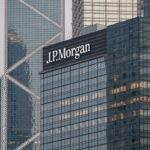
NEW YORK, April 14, 2026. Bank earnings super Tuesday opens with JPMorgan Chase delivering one of the most impressive single-quarter prints in the firm’s history — and with oil retreating from Monday’s blockade-driven highs as Trump confirmed that Iran has reached out seeking to resume negotiations. JPMorgan reported Q1 2026 EPS of $5.94 — a $0.49 beat above the $5.45 consensus — with managed net revenue of $50.5 billion, net income of $16.5 billion (+13% YoY), and a Return on Tangible Common Equity of 23%. Investment banking fees rose 28% year-over-year. Markets revenue jumped 20%. Assets under management in the Wealth division reached $4.8 trillion. Wells Fargo reported a slight EPS beat ($1.60 vs $1.59) but missed on revenue ($21.45B vs $21.77B), with CEO Charlie Scharf highlighting 15% EPS growth and $4 billion in share repurchases. Citigroup reports this morning — consensus EPS $2.63, revenue ~$23.5B — and Jane Fraser’s mid-teens IB guidance will be the framework for the reaction. March PPI releases at 8:30 AM. WTI retreated to ~$96–97 on Tuesday morning — down approximately 2.7% from Monday’s $99 close — after Trump confirmed Monday afternoon that Iran had “called” seeking a resumption of dialogue.
Monday’s close — how the S&P got back into the green for 2026
Monday’s session produced the most consequential single trading day of the Iran war period: the S&P 500 closed +1%, reaching its highest level since late February and erasing all losses accumulated since the February 28 outbreak of Operation Epic Fury — putting the index back in positive territory for 2026. The catalyst was Trump’s afternoon confirmation, speaking to reporters at Joint Base Andrews, that Iran had “called” Washington seeking to resume negotiations after the Islamabad breakdown. NBC News reported the comment sent stocks to their session highs and drove crude off its morning peak. The Nasdaq closed +1.2%; the Dow gained 302 points. That recovery came despite Goldman Sachs — whose Q1 results had opened the session — sliding 1.9% after a FICC revenue miss that disappointed traders expecting the Iran war’s commodity volatility to deliver an exceptional trading quarter. The Goldman FICC miss is covered in today’s separate deep dive; what matters for Tuesday’s open is that the S&P absorbed a Goldman disappointment, a $99 WTI close, and an active naval blockade — and still closed at its highest level in six weeks. That is a structurally bullish signal about the market’s Iran-war ceiling.
France and the UK added a constructive diplomatic wrinkle. French President Macron announced preparations for a “peaceful multinational mission aimed at restoring freedom of navigation” in the Strait of Hormuz, to be co-organized with Britain — a conference to be convened “in the coming days.” UK Prime Minister Starmer characterised it as “a coordinated, independent, multinational plan to safeguard international shipping when the conflict ends.” The multilateral involvement of France and the UK — both permanent UN Security Council members with significant naval capability — introduces a third diplomatic channel beyond the US-Iran bilateral track, and provides a face-saving framework for any eventual Hormuz normalisation agreement that neither side can present as a concession. Pre-market futures Tuesday morning are pricing a largely constructive open — led by JPMorgan’s massive beat — with oil’s retreat providing additional support to rate-sensitive and consumer-exposed names.
JPMorgan — what EPS $5.94 and ROTCE 23% actually mean
JPMorgan Chase’s Q1 2026 result is not just a beat — it is the single strongest quarterly print from any major US bank in recent history by the profitability metrics that institutional investors weight most heavily. A 23% ROTCE — Return on Tangible Common Equity — at a $4.9 trillion asset institution is an extraordinary operational achievement. Peers like Bank of America historically target 15–16% ROTCE, Citigroup is aiming for 10–11%, and Wells Fargo delivered 14.5% this quarter. JPMorgan’s 23% is a level of capital efficiency that would be remarkable for a mid-cap financial; at the world’s largest bank by assets, it is the definition of scale advantage made quantifiable. The IB fee growth of 28% year-over-year confirms that the M&A revival that Goldman’s advisory business was supposed to capture in Q1 did materialise — JPMorgan’s franchise captured a disproportionate share of it. The 20% Markets revenue growth validates that the Iran war’s volatility across commodities, rates, and currencies did produce exceptional trading quarters — just apparently more so in equities (where JPMorgan and Goldman both delivered strong numbers) than in FICC (where Goldman missed). Credit costs of $2.5 billion — down from $3.3 billion a year ago — with only a $191 million reserve build is the most important consumer credit quality signal of the Q1 earnings season: it means JPMorgan’s risk team sees no material deterioration in the loan book despite $4+ gasoline, elevated inflation, and six weeks of war-driven consumer anxiety. Jamie Dimon’s prepared remarks on the economic outlook and the war’s consumer durability implications will be the most market-influential single statement of the Tuesday session.
Wells Fargo — EPS beat, revenue miss, and the asset cap absence
Wells Fargo’s Q1 2026 is a textured result rather than a clean beat. EPS of $1.60 included $135 million, or $0.04 per share, of discrete tax benefits related to prior period tax resolution — meaning the underlying operational EPS was closer to $1.56, consistent with some analysts’ estimates rather than a clean beat on the headline. Revenue of $21.45 billion missed the $21.77 billion consensus, driven by slightly softer-than-expected net interest income and lower mortgage banking fees following the rate environment’s effect on origination volumes. The constructive elements: NII grew 5% year-over-year, noninterest income rose 8% on improved venture capital results and higher wealth management fees, Markets revenue surged 19%, and IB revenue grew 11% — confirming the same M&A and trading tailwinds visible in JPMorgan’s print. CEO Charlie Scharf: “We saw continued positive impacts from the investments we have been making with diluted earnings per share increasing 15%, revenue increasing 6%, loans increasing 11%, and deposits increasing 7% compared to a year ago.” The $4 billion in share repurchases in a single quarter is the most aggressive capital return pace Wells Fargo has executed in several years, reflecting Scharf’s confidence in the capital position even without the Federal Reserve’s longstanding asset cap being formally lifted. The asset cap’s continued absence from Tuesday morning’s press release — no announcement, no timeline — is the structural overhang that will dominate the Q&A and prevent a full re-rating of WFC despite the solid underlying performance metrics.
Citigroup this morning — Fraser’s “front foot” moment
Citigroup reports Q1 2026 before Tuesday’s open. Consensus: EPS $2.63 (vs Q1 2025’s $1.96, representing approximately 34% growth) and revenue approximately $23.4–23.5 billion. CEO Jane Fraser had explicitly guided to “mid-teens percentage growth in Q1 investment banking fees and markets revenue” at the March 10 RBC Capital Markets conference — a confident forward commitment that JPMorgan’s IB +28% and Markets +20% results suggest the broader banking environment supported fully. The key metric for the Citi reaction will be ROTCE: if the quarter delivers the 10–11% annual ROTCE target on a quarterly basis, it validates the transformation thesis that the stock has been pricing. If it falls below 9%, the May 7 Investor Day — where Fraser is expected to map a credible path to higher ROTCE targets — becomes the market’s next inflection point rather than a confirmation event. The Apollo $25 billion private credit partnership and the discontinued Russia operations are the two structural elements that most distinguish Citi’s Q1 revenue mix from its peers. Goldman Sachs analyst Richard Ramsden had raised his Citi target to $137 (from $123) on April 6, reflecting confidence in the transformation trajectory before the Q1 data.
March PPI at 8:30 AM — the producer-side inflation read
The Bureau of Labor Statistics releases the March Producer Price Index at 8:30 AM ET Tuesday — the producer-side complement to Friday’s CPI. March PPI is expected to show an energy-driven headline surge consistent with the CPI’s +0.9% MoM / +3.3% YoY print, with the same gasoline and energy pass-through visible at the wholesale production level. For the Federal Reserve’s policy framework, PPI’s core reading — which strips food and energy — will be the sub-component that carries the most weight: if core PPI is also accelerating, it suggests the Iran war’s energy costs are beginning to diffuse into wholesale goods pricing, which would be an early leading indicator of broader consumer price second-round effects in coming months. With the FOMC blackout beginning Saturday April 18, Tuesday’s PPI is the last major inflation data point before policymakers go dark ahead of April 28–29. Any Fed speakers who comment on Tuesday’s PPI and the JPMorgan results before Saturday’s blackout are delivering the final official policy signals the market receives ahead of the April meeting. PreMarket Daily’s full daily plan covers every session’s catalyst — Tuesday’s primary watchpoints are JPM’s call (Dimon on consumer credit and war duration), Citi’s results, and PPI at 8:30.
This article is published by PreMarket Daily for informational and educational purposes only. Nothing here constitutes financial advice, investment recommendations, or an offer to buy or sell any securities. Always consult a qualified financial professional before making investment decisions.