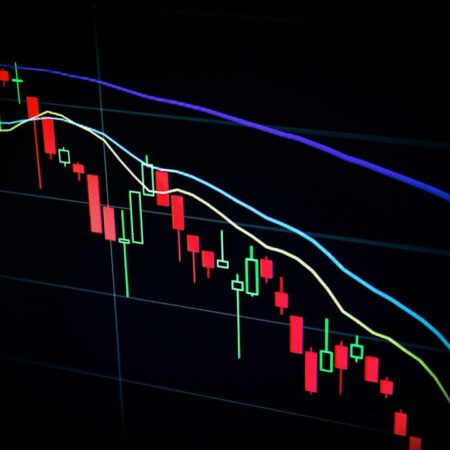
NEW YORK — The Nasdaq Composite fell 2.60% to 26,008.86 Thursday — its worst single session since June — as two of the market’s most closely watched AI names delivered results that answered the wrong question: not whether the money was coming in, but whether the money going out was worth it.
The S&P 500 dropped 1.21% to 7,663.43, its worst day since July. The Dow Jones Industrial Average finished essentially unchanged at +0.02%, or +11.89 points to 52,867.98. Russell 2000 futures pointed to a decline of roughly 0.95%. The index divergence was not coincidence — it was the market sending a clear message about where the pain was concentrated.
When Beating Estimates Isn’t Enough
Meta Platforms reported adjusted diluted EPS of $7.40 for Q3, comfortably above the Street’s $3.83 GAAP consensus once the $9.89 billion litigation charge is stripped out. Revenue rose 26% year-over-year to $64.6 billion. On the surface, those are not the numbers that cause a nearly 7% stock decline. What caused the decline was the forward guidance: Q4 revenue of $73 billion to $76 billion was broadly in line, but full-year capital expenditure guidance was raised to $135 billion to $145 billion as Meta accelerates AI infrastructure spending. Operating margin came in at just 20% for the quarter — and would have been 35% without the legal charge. Investors are now doing the math on what $145 billion in annual capex does to margins structurally, and they don’t like the answer.
Tesla’s Q3 results were a cleaner story, and yet the stock still fell 3.08%. Adjusted EPS of $0.48 beat the $0.4488 consensus, auto gross margins came in at 18.1% versus a 16.7% estimate, and adjusted EBITDA of $3.90 billion topped the $3.66 billion forecast. Revenue of $28.05 billion missed by roughly $11 million — barely a rounding error. Tesla’s decline Thursday had less to do with its own numbers and more to do with the AI spending narrative dragging the entire complex lower.
The Two Markets Living Inside One Index
Thursday’s session put the bifurcation thesis on full display. While the Nasdaq bled, the consumer staples sector rose 2.1%. Procter & Gamble surged 5.58% to $165.59 after reporting Q3 EPS of $2.00 against a $1.89 consensus estimate — a 5.82% beat that reminded the market that there are still companies generating predictable cash flows without needing to build data centers. General Mills added 6.6%. Services and Financials each gained 1.5%. The Dow’s flat close is the arithmetic result of that divergence — energy names and consumer defensives offsetting the tech drag in a blue-chip index that carries far less Nvidia exposure than the Nasdaq.
The rotation is real, but traders should be careful about overstating its durability. As we examined earlier Thursday, the AI trade and the rest of the market have been moving almost independently for weeks. When AI names pull back, money finds a home in defensives and small caps — but that dynamic depends on the rotation remaining orderly. A disorderly AI unwind, triggered by something like a major guidance cut or credit event at a debt-heavy infrastructure player, would be a different conversation entirely.
CoreWeave illustrated exactly that risk. Shares sank 10.06% as investors revisited the company’s debt-heavy balance sheet in the context of higher-for-longer capital costs. When the cost of money rises and the timeline for AI monetization remains uncertain, leveraged infrastructure plays are the most exposed. SOXL, the 3x leveraged semiconductor ETF, fell 18.2% to $84.50. Nokia dropped 12.9% to $8.06. These are not subtle moves.
Oil, Bonds, and the Macro Overlay
The session’s macro backdrop amplified the earnings-driven moves. Oil prices surged to a five-month high on escalating Iran-related geopolitical tensions, pushing energy costs higher and injecting an inflation wildcard into a market that had grown comfortable with a disinflationary trajectory. Investors rotated into Treasuries, sending yields lower — a flight-to-quality move that historically signals risk-off sentiment even when the move itself is modest. Higher oil is a direct threat to the “soft landing” narrative, and any renewed inflation pressure would complicate the Fed’s path. That intersection of geopolitics, energy prices, and rate expectations is worth monitoring closely into Friday. For more context on how yield dynamics are shaping the equity tape, see our earlier analysis: Is the 5% Yield Barrier Finally Breaking Equities Open?
SpaceX shares dropped 8.1% to $146.43, extending recent pressure on high-profile AI and space infrastructure names. The Nasdaq Composite now sits 5.4% below its all-time closing high of 27,599.89 set on October 6. That’s not yet a correction by the conventional 10% definition, but the speed of the drawdown — concentrated almost entirely in AI and chip names — means the technical damage in those individual stocks is already severe. The question is whether the index-level decline understates the real pain in portfolios overweight to the AI complex.
After Hours: IBM Steadies, Lam Research Slips
IBM reported Q3 revenue of $17.1 billion, beating the Street’s $16.87 billion forecast, and traded up nearly 3% after hours to around $240. That gain may prove fragile — IBM was subsequently trading down 4.52% to $240.12 in extended hours as the session wore on, suggesting some giveback after the initial enthusiasm. Meta recovered modestly in after-hours trade, up 2.36% to $713.88, but that does not erase a nearly 7% regular-session loss. Lam Research fell 6.56% to $243.44 after hours, continuing the semiconductor equipment sector’s rough session. Molina Healthcare dropped 4.47% to $205.30. On the positive side, RingCentral surged 15.0% to $91.30 after hours, and Robert Half jumped 12.2% to $42.26 — earnings-driven moves in names that had little to do with Thursday’s AI-driven narrative.
What Friday’s Open Needs to Answer
The setup heading into Friday is uncomfortable but not disorderly. Breadth data from Thursday offers a sliver of reassurance: the S&P 500 logged 40 new 52-week highs against just 4 new lows. But the Nasdaq told a different story — 82 new highs against 342 new lows. That internal divergence confirms what the price action already showed: this is a sector-specific event, not a market-wide break. Whether it stays that way depends on how aggressively the AI capex concern spreads to the broader earnings narrative over the next two weeks. The AI earnings cycle is under the microscope like never before.
| Level / Event | Value | Signal |
|---|---|---|
| Nasdaq-100 key level | 29,000 | Clean break below here on Friday’s open signals a deeper repricing of AI names, not just a one-day flush |
| Russell 2000 Futures support | 2,760 | Holding this level overnight confirms rotation trade absorbing tech outflows; a break weakens the soft-landing argument |
| S&P 500 session low | 7,647.14 | Key intraday support; a Friday open below this level with volume invites technical sellers |
| META after-hours recovery | $713.88 | 2.36% after-hours bounce; watch whether this holds into Friday’s open or fades — sets the tone for AI sentiment |
| Nasdaq all-time high | 27,599.89 | Index now 5.4% off its October 6 record; a continued slide toward 10% drawdown would reclassify this as a correction, not a rotation |
Thursday’s session did not break the market. But it did break something more important — the assumption that AI companies can keep raising their spending targets without the market demanding a credible payback timeline. P&G at $165 and IBM at $240 remind us that there are earnings stories working well right now. The problem is that the Nasdaq is not built around P&G. Friday’s open will tell us whether institutional money decides Thursday was a buying opportunity or the beginning of a more serious reckoning with AI’s cost structure. Neither conclusion is obvious yet, and anyone claiming certainty here is selling something.
This article is published by PreMarket Daily for informational purposes only. Nothing here constitutes financial advice, investment recommendations, or an offer to buy or sell any securities. Always consult a qualified financial professional before making investment decisions.


Market Update
Is Meta’s $145 Billion Capex Bet Breaking the AI Trade?




No Comment! Be the first one.